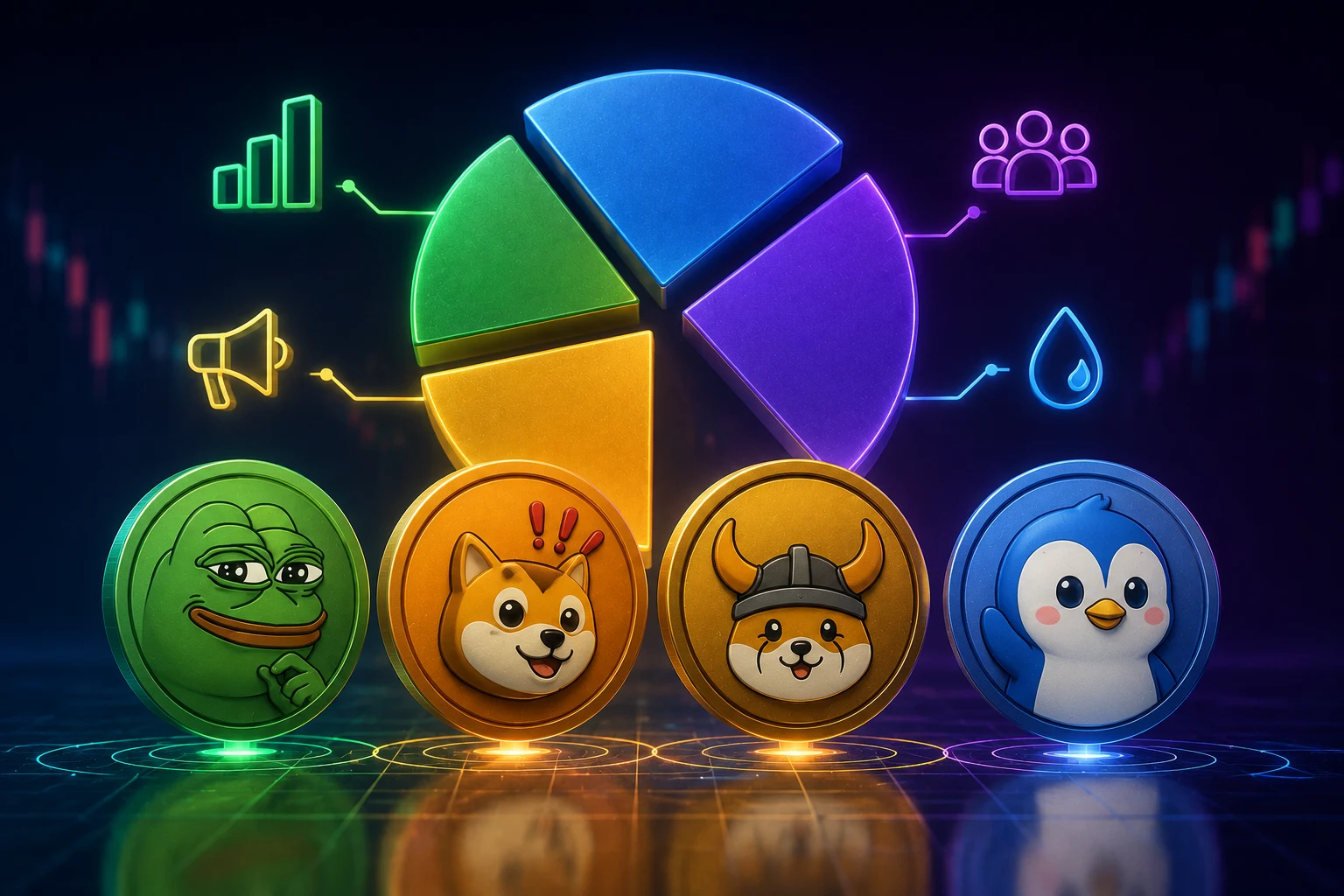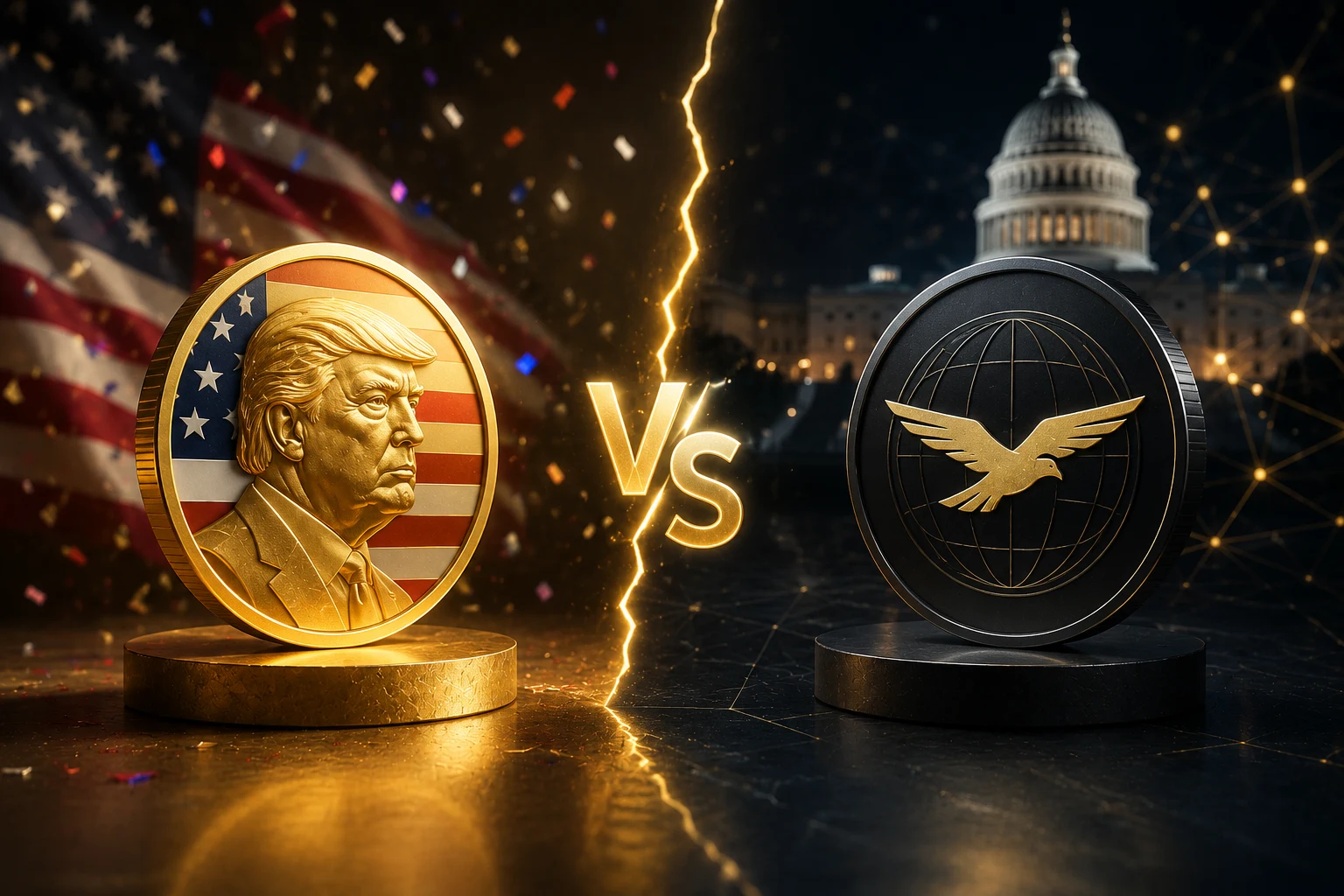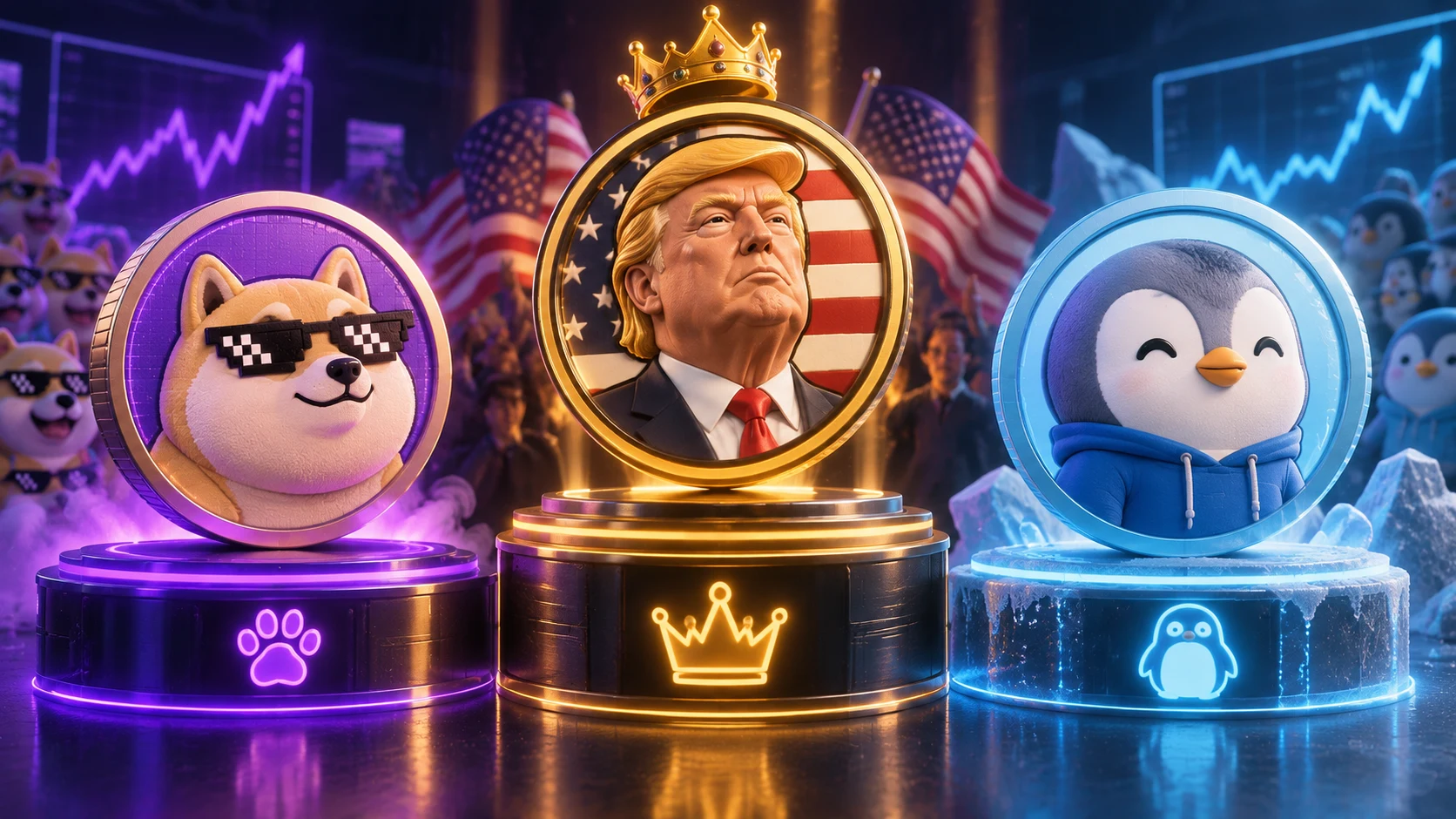
Three meme-flavored tokens, three very different bets
Meme coins are tokens whose primary value driver is community, narrative, or internet culture rather than cash flow, fee revenue, or technical innovation. The category is famously volatile: a token can several-x in a week and then bleed for a year. Comparing three of them is less about picking a winner and more about understanding the different bets each one is asking you to make.
MemeCore's M token bills itself as a 'cultural meme chain,' marketing the idea that meme culture itself is the product, not any single meme. Official Trump's TRUMP token is a politically themed coin launched around the persona of a sitting US president, a sub-category that exploded in early 2025. Pudgy Penguins' PENGU sits at the intersection of NFTs and meme tokens, drawing on the brand equity of the Pudgy Penguins NFT collection, which peaked in 2021 and 2022 and survived the broader NFT wipeout.
All three are speculative. All three trade primarily on attention, narrative, and community sentiment. The structural differences are what matter for anyone thinking of allocating to any of them: who holds the supply, when does the rest unlock, what is actually behind the brand claim, and how thin is the order book when you try to exit. Comparing the three on those terms is more useful than comparing price charts.
This article walks through each of those dimensions using the same framework for every token, then closes with a short checklist for evaluating the next meme launch that trends on social media.
The risks that come with every meme token
The honest starting point for any meme token comparison is that this category has a higher failure rate than almost any other corner of crypto. The 'risks' section comes second on purpose, because it is the single most important thing to internalize before reading the rest of this article.
Meme tokens typically fail in recurring ways. The most common is rug-pull risk, where a small group of insiders holds a large share of supply and dumps on retail after the launch pump. The second is narrative decay, where the joke, brand, or celebrity tie-in stops trending and trading volume collapses. The third is unlock overhang, where tokens held by the team, treasury, or private investors unlock slowly over months or years, creating a constant flow of sell pressure that mutes any organic rally. The fourth is liquidity evaporation, where the order book on decentralized exchanges gets thin and small holders cannot exit at any reasonable price. The fifth is smart-contract risk, since many meme tokens launch with minimal auditing and upgradeable contracts that the team can change.
These risks are not theoretical. A widely cited 2024 study by Chainalysis estimated that roughly one in four new tokens launched on DEXs showed signs of 'soft rugs,' where the team abandons the project without doing an outright exit scam. Even legitimate meme coins that survive their first year commonly see drawdowns of 80% to 95% from their all-time highs. Survivorship bias is real: people remember the SHIB and DOGE winners and forget the hundreds of celebrity and brand-themed tokens that quietly went to zero.
For each of M, TRUMP, and PENGU, these risks apply in different shapes. The remainder of this article looks at how the on-chain structure of each token changes the probability and severity of those failure modes. But the baseline expectation should be that any of these tokens could lose most of its value in a bear market, a narrative shift, or a coordinated insider exit. Allocating to meme tokens is closer to buying a lottery ticket than to investing in a business.
Tokenomics compared: supply, unlocks, and what actually circulates
Tokenomics is the term for the supply, distribution, and release schedule of a token. It is the single most important variable for whether a meme coin can sustain a price over time, and it is where M, TRUMP, and PENGU diverge sharply.
MemeCore's M token launched with a supply in the billions and a circulating float that increased over time through a combination of staking rewards and ecosystem incentives. The 'cultural meme chain' framing is meant to justify a wide distribution rather than a small insider circle, since the stated goal is for M to serve as gas and staking collateral across an ecosystem of meme-themed apps and tokens. The on-chain reality is more nuanced. A significant share of M is held by early backers and a foundation treasury, and the unlock schedule for those allocations has stretched over multiple years, mirroring the typical Layer 1 token release pattern.
Official Trump's TRUMP token had one of the most concentrated insider allocations of any major 2025 launch. Reports and on-chain tracking at launch showed that roughly 80% of the supply sat with the issuing entity and a small group of affiliated wallets, with the public float limited to about 20%. The unlock schedule for the team and treasury tokens was set to drip out over three to four years, a structure that creates a structural overhang even when the price is rising. This is the same pattern that plagued earlier celebrity tokens, where early holders could exit into retail buying pressure and then let the slow unlock distribute selling into the next cycle.
PENGU's structure is the most different of the three. Pudgy Penguins had an existing NFT treasury and brand revenue before launching the token, and a meaningful portion of the PENGU supply was airdropped to existing Pudgy Penguins and Lil Pudgy holders. That gave the token a wider initial holder base than the typical meme coin launch, though the top-holder concentration on-chain is still skewed toward the team treasury and the Pudgy Penguins parent company, Igloo Inc. The token also has a smaller total supply than M or TRUMP, which mechanically means each unit represents a larger share of the project.
Where the supply sits: holder concentration
Holder concentration is the percentage of a token's supply held by the top wallets. A high concentration means a small number of addresses control the float and can move the price with a single sale. A low concentration means the supply is more diffuse and harder for any one actor to dump. For meme tokens, holder concentration is often a better predictor of price action than the whitepaper.
On launch, M had a top-10 holder concentration of roughly 40% to 50%, depending on the day measured, with the largest wallet believed to be a foundation or vesting contract. That is moderate for a meme coin but still leaves the project sensitive to coordinated selling by early insiders. The next tier of wallets included centralized exchange hot wallets used for liquidity, which is healthier because those balances tend to be more stable, and a long tail of smaller holders that grew as staking rewards and ecosystem incentives distributed tokens outward.
TRUMP's concentration was the most extreme of the three at launch. The top-10 wallets held well over 70% of circulating supply within the first week, and the top wallet alone held roughly 60%. Some of that is locked in vesting contracts, which is healthier than insiders holding free-floating tokens, but the unlock schedule means the float will roughly double or triple over the next three years as those contracts release. For holders today, the practical implication is that the price floor is partly a function of when team and treasury tokens become liquid, not just of organic demand.
PENGU's initial concentration was lower than TRUMP's but higher than M's. Top-10 holders controlled roughly 50% to 60% of supply early on, with the largest wallets including the Pudgy Penguins treasury and centralized exchange hot wallets used for liquidity provisioning. The airdrop distribution added thousands of smaller holders, which is a structural advantage for any retail-led token. As PENGU has traded, the concentration has gradually dispersed, though the project treasury remains a meaningful share of supply that has the option to sell over time.
The takeaway: even the 'most distributed' of these three tokens has meaningful insider concentration, and the 'least distributed' of them has a multi-year unlock schedule that materially affects price. None of the three is comparable to a deeply liquid, broadly distributed token like BTC or ETH.
Brand, IP, and 'utility': do they actually backstop a meme?
Meme coin projects increasingly justify their valuation with two words: brand and utility. The brand argument is that a recognizable name (a president, a cartoon penguin, a meme character) gives the token a durable demand floor that pure community tokens lack. The utility argument is that the token will be used for staking, governance, payments, or in-game economies, giving it real cash flow or fee capture.
The honest answer is that both arguments are weaker than they sound. Brand recognition is not the same as brand loyalty. The 2022 NFT crash wiped out most major NFT brand tokens because holding a token tied to a brand required the brand to keep trending, which most brands did not. Bored Ape's APE token launched near $40 and traded below $1 within 18 months. Other celebrity and brand tokens followed the same path, even when the underlying brand was a globally recognized name. The lesson is that brand interest is conditional on attention, and attention is fickle.
Utility claims on meme tokens are even more suspect. Staking yields on tokens that have no fee generation are paid in the same token, which is inflationary and self-referential: new tokens are minted to pay stakers, diluting everyone else's share. Governance rights on tokens where one foundation controls most votes are nominal. Game integrations and payment use cases are usually tiny relative to the circulating supply and rarely generate meaningful buy pressure.
PENGU is the strongest of the three on this dimension because the Pudgy Penguins brand has actually shipped consumer products (plush toys, licensing deals) and survived the 2022 NFT wipeout with a recognizable name. Even so, the Pudgy Penguins brand alone does not justify PENGU's valuation at any specific number. The token could still lose 80% or more if the broader crypto market turns or if the brand cools off. M and TRUMP rely on weaker claims: a vague 'cultural' thesis in M's case and a politically driven narrative in TRUMP's case. Neither has a track record of holding attention through multiple cycles, which is the bare minimum test for any brand-anchored meme.
Past meme coin wipeouts and what they teach
Studying the wipeouts is more useful than studying the survivors, because the wipeouts reveal the failure patterns that hit most tokens in this category. A short, non-exhaustive list of well-documented cases makes the point.
Bored Ape's APE token launched with one of the strongest brand claims in crypto, tied to the most valuable NFT collection of the 2021 cycle. By late 2023, APE had lost roughly 95% from its high, the NFT collection's floor price had collapsed by similar magnitudes, and the project had undergone multiple leadership changes. The lesson: even the strongest NFT brand at the peak of an NFT cycle did not protect its token, and the brand kept existing while the token's value evaporated.
Celebrity tokens from the 2022 to 2024 wave, including coins launched or endorsed by athletes, musicians, and influencers, mostly followed the same arc. A small launch pump on announcement, distribution to retail over days or weeks, and then a long grind lower as insiders exited and narrative attention moved on. Tokens associated with major sports figures, music artists, and reality TV personalities illustrate the pattern, with most losing 90% or more from their initial peak within twelve months.
Politically themed tokens are a more recent sub-category but have already produced wipeouts. Tokens launched ahead of US election events in 2024 spiked on news, then collapsed as the news cycle moved. TRUMP is the largest survivor in this sub-category, but the same structural risks apply: insider concentration, narrative dependency, and unlock overhang.
The few meme tokens that have survived multiple cycles, primarily DOGE, SHIB, and PEPE, share two traits that newer launches usually lack. They were either the first mover in a sub-narrative, or they built genuinely persistent communities rather than riding a single news event. PENGU has a better claim to persistent community than TRUMP or M, but 'better' is not 'safe.' It just means the brand has a non-zero chance of still being recognized in three years. None of the three tokens in this comparison has yet proven it can hold attention through a full crypto cycle.
How to evaluate meme tokens yourself
Comparing M, TRUMP, and PENGU is useful, but the deeper skill is being able to evaluate the next meme token that trends on social media without trusting the project's marketing. A simple checklist helps.
First, look at the supply schedule. Find the unlock or vesting contract on-chain and see how much is held by the team, treasury, and private investors, and when those tokens become liquid. A multi-year unlock for a large share of supply is a yellow flag for any meme coin. Second, look at the holder distribution. Use a block explorer or a holder concentration tool to see what percentage the top 10 or top 100 wallets control. Anything above 60% for top 10 wallets on launch is a meaningful concentration risk.
Third, look at liquidity. Find the token's main liquidity pools on DEXs and check the total value locked. Thin liquidity means even a small sale can move the price sharply against you, and a market maker disappearing can make the token effectively un-tradable. Fourth, look at brand durability. Ask whether the brand, IP, or person behind the token has a track record of attention across multiple cycles, not just one news event. Pudgy Penguins passes that bar; most political and celebrity tokens do not.
Fifth, look at contract permissions. Check whether the token contract is upgradeable, whether minting is still enabled, and whether there are blacklist or freeze functions. Any of these can be used by the team to disrupt holders. Sixth, look at the team. Anonymous teams are the norm in this category, but fully doxxed teams with a public track record are a positive signal, and known serial ruggers are a hard negative. Finally, apply position-sizing rules that match the risk. Most experienced traders recommend allocating only a small percentage of a portfolio to any single meme token, often less than 1% to 2%, and having a pre-committed exit plan rather than waiting for the price to come back. None of these tools guarantees a profit, but they do reduce the probability of a total loss and force you to make decisions before emotions take over.
How to follow the meme token space the smart way
Meme tokens move on narrative, and narratives move faster than any human can read. Tracking each launch, each unlock, and each concentration shift manually is a losing game for most retail participants. Zippfeed surfaces meme token and broader crypto headlines with sentiment scoring (bullish, neutral, or bearish) and an importance rating, so you can filter signal from noise and react to structural news like unlock events or major wallet movements rather than chasing the next viral post.


 TheBlock