








 CoinDesk

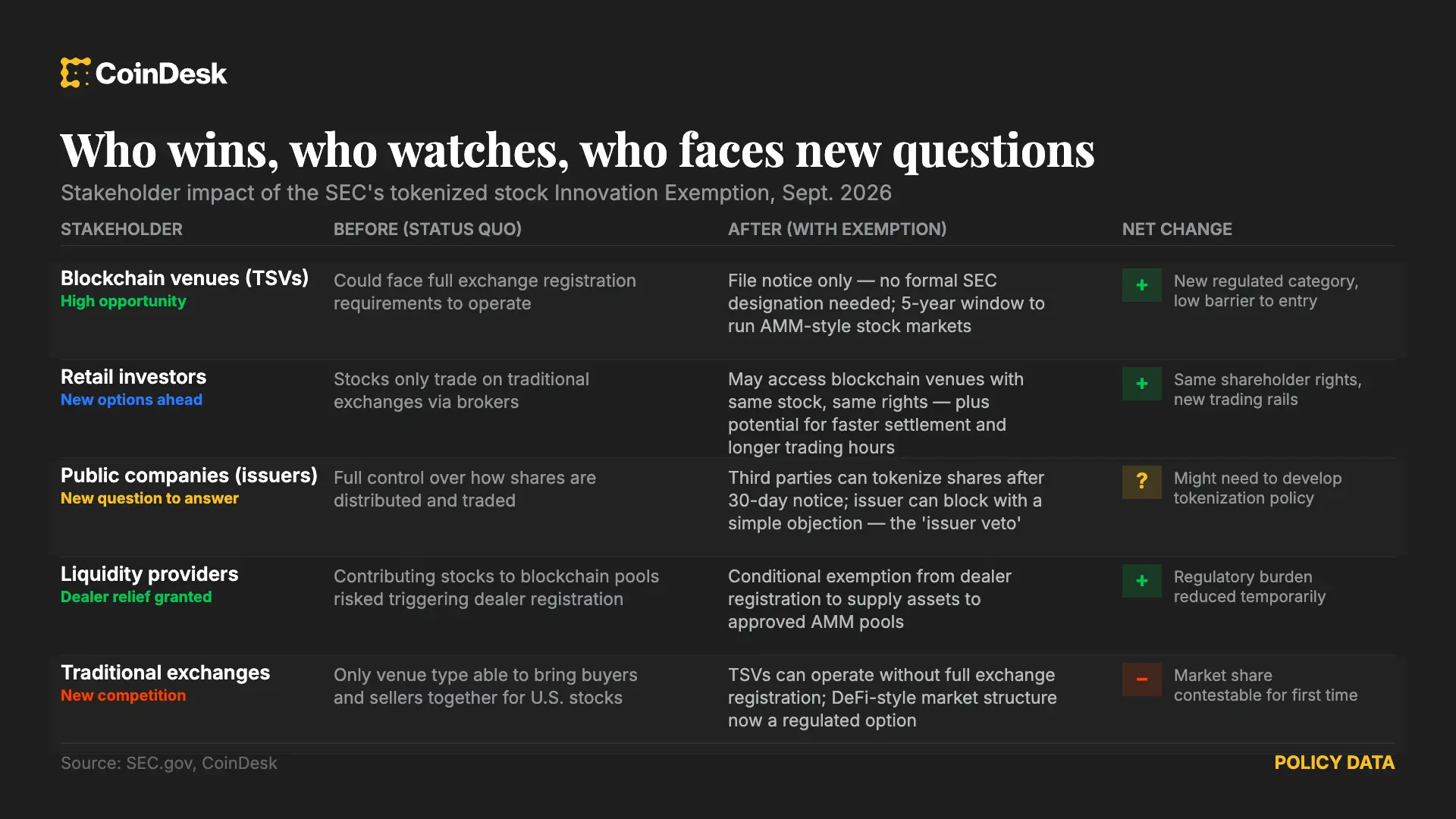


The SEC unveiled a five-year "innovation exemption" on Thursday that lets qualifying platforms trade tokenized U.S. stocks on public blockchains without registering as national securities exchanges. Tokenized Securities Venues, or TSVs, can route eligible U.S. equities through smart-contract liquidity pools and automated market makers, while certain liquidity providers get conditional relief from dealer registration.
The framework draws a hard line between tokens that carry full shareholder rights and synthetic products that merely track a stock's price. To qualify, a token must preserve voting and dividend rights, halt when the underlying share halts, and run on public, auditable software deployed on a permissionless chain. Access to the venue itself stays permissioned. The most-liquid tier is capped at 75 names per venue and 0.25% of average daily volume, with a second tier allowing 250 names and 2.5%, per SEC Trading and Markets director Jamie Selway.
The exemption dropped a day after the Clarity Act failed to clear the Senate, signaling Chair Paul Atkins is willing to use the agency's existing authority while Congress stalls.
Why it matters
This is the first defined U.S. regulatory lane for trading tokenized equities, not just holding them. Earlier in September the SEC proposed letting the blockchain serve as the official ownership record; Thursday's exemption tackles where and how those stocks actually change hands. Securitize CEO Carlos Domingo called it a "super good middle ground" that lets crypto-native market structure run under securities-law guardrails.
The plumbing matters because it changes who can intermediate U.S. stock trades. Banks, brokers and crypto firms can now experiment with AMM-style execution alongside traditional order books, and Securitize expects multiple onchain liquidity venues to emerge.
Market impact
Caps are deliberate. Tesla, with roughly 40M average daily shares, could see about 100,000 tokenized shares traded per qualifying venue, worth around $36.6M at $366, a controlled first pass. Issuers retain a 30-day pre-listing notice and an explicit veto, the safeguard Fairmint CEO Joris Delanoue calls the framework's key protection, and a direct response to this month's AMC-Robinhood dispute.
Perp-style synthetic equity products on venues such as Hyperliquid stay outside the lane because they offer derivative, not ownership, exposure. For five years the SEC is treating this as a live experiment: small enough to measure, broad enough to test whether DeFi plumbing can carry regulated U.S.

Frequently asked questions
-
What did the SEC actually announce for tokenized U.S. stocks?
A five-year "innovation exemption" that lets qualifying Tokenized Securities Venues trade eligible U.S. equities on public blockchains through smart contracts and AMM-style liquidity pools, without registering as national securities exchanges.
-
What are the trading-volume caps under the SEC's tokenization sandbox?
The most-liquid tier is limited to 75 names per venue and 0.25% of average daily trading volume. A second tier allows 250 names and up to 2.5% of average daily volume, per SEC Trading and Markets director Jamie Selway.
-
Can issuers block someone else from tokenizing their stock?
Yes. Before a venue lists a tokenized share created by an unaffiliated third party, the issuer gets 30 days' notice and can object, including a flat refusal to have its securities tokenized on that venue.
-
Do synthetic tokenized stocks and equity perps qualify for the exemption?
No. Tokens must preserve voting and dividend rights and halt when the underlying share halts. Synthetic price-tracking tokens and equity perpetuals such as those on Hyperliquid fall outside the framework because they offer derivative, not ownership, exposure.
-
Why did the SEC move now, right after the Clarity Act failed?
The Clarity Act fell short of 60 votes in the Senate on Tuesday. A day later Chair Paul Atkins said the agency would use its existing authority, and the tokenization exemption followed, signaling SEC-led rulemaking while Congress stays stalled.
 Crypto News
 CoinTelegraph
 CryptoSlate
 WuBlockchain