Why these three tokens get compared at all
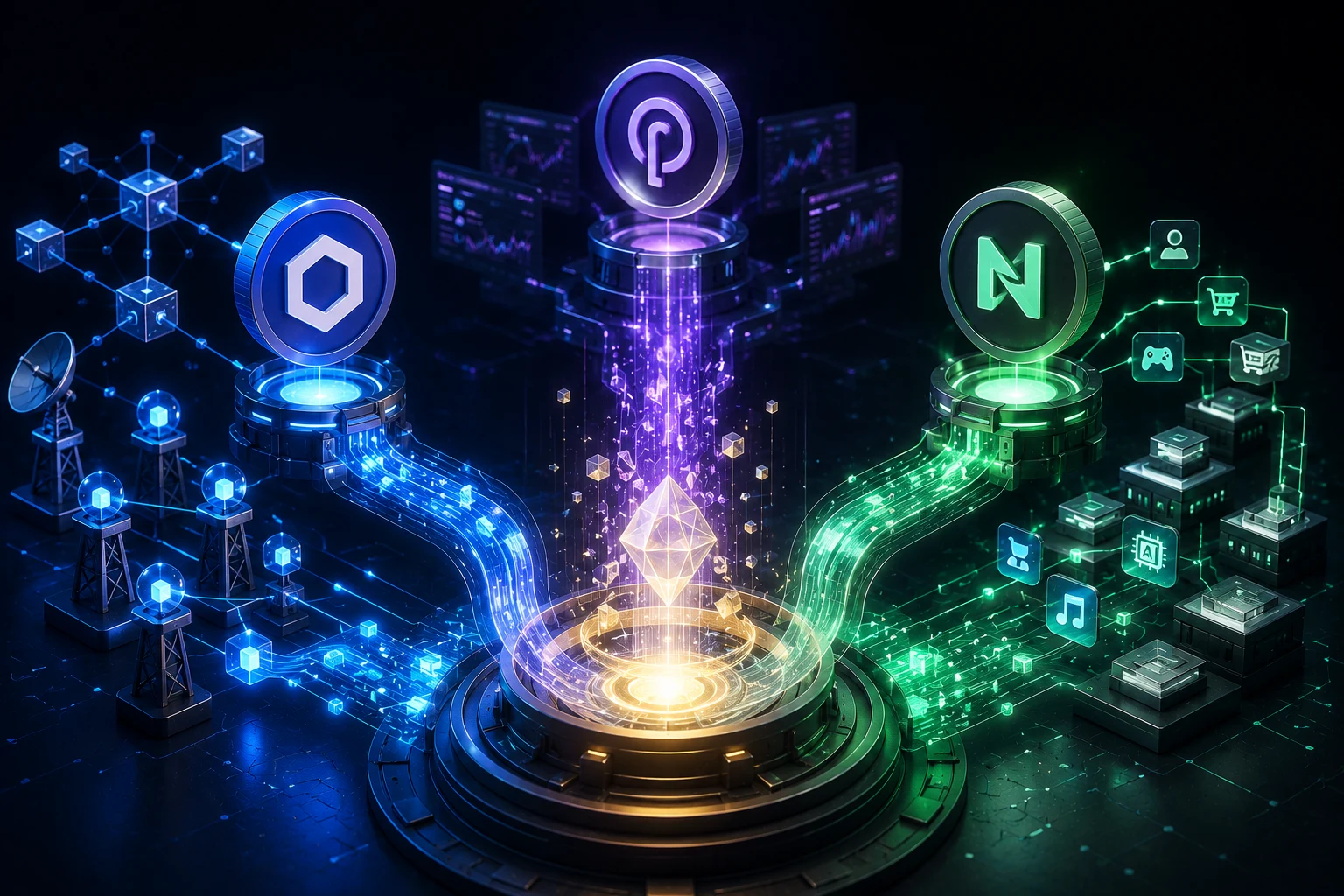
Beginners often notice that LINK, PYTH, and NEAR all sit near the boundary between blockchains and the outside world. Chainlink is the long-running oracle network that pipes price data into DeFi. Pyth is a newer price-feed project that emerged on Solana. NEAR is a layer-1 blockchain that, after an AI-themed rebrand, also leans on the 'real-world data meets crypto' story. On a chart they look like neighbors; under the hood they are three very different machines.
The honest answer to 'which of these tokens is a real bet on data?' is that only two of them actually sell data as their product. LINK and PYTH monetize price feeds directly. NEAR monetizes blockspace, with data and AI as a marketing layer on top. If a reader came in thinking all three were oracle tokens, that assumption is worth correcting early.
It also helps to define 'token economics' before comparing. Token economics refers to how a token is created, who gets it, what holders can do with it, and whether demand for the token is linked to real product usage. Two tokens can both have inflation and staking, and still be fundamentally different assets if one has external users paying fees and the other does not.
What risks should a buyer of LINK, PYTH, or NEAR know up front?
Before the deep dive, the risks. These are tokens with public price history, not savings accounts, and each has a different danger profile.
Market and narrative risk. All three are exposed to crypto-wide drawdowns. A long quiet market hurts tokens that rely on new users paying for services, because fees fall faster than emissions adjust.
Unlock and dilution risk. PYTH and NEAR both have sizable insider or VC allocations that unlock over multi-year schedules. When these tranches vest, they often appear on the market as sell pressure. LINK's early investors are long since liquid, but its team treasury still holds a meaningful stack and moves it occasionally.
Revenue vs emissions risk. The single biggest analytical trap in this corner of crypto is confusing 'real revenue' (fees paid by external users) with 'token flows' (tokens paid out to validators, publishers, or stakers by the protocol itself). Many dashboards mix the two. A token can post huge 'revenue' numbers that are really the protocol paying its own stakeholders in freshly minted tokens.
Smart contract and dependency risk. Oracles carry a special category of risk: if the oracle is wrong, every protocol that reads it can be wrong. Chainlink has had mispricing incidents; Pyth's pull model has different failure modes. NEAR, as an L1, inherits general chain-level risk plus any bugs in its AI or data components.
How Chainlink's LINK token actually works
Chainlink is a decentralized oracle network. Off-chain nodes fetch real-world data, such as asset prices, sports results, or weather readings, and post it on-chain so smart contracts can read it. DeFi protocols, including Aave and many derivatives venues, pay for these feeds.
The LINK token has three main jobs inside that system. First, node operators are typically paid in LINK for delivering data. Second, LINK is staked by node operators as a security deposit, which can be slashed (taken away) if they behave dishonestly. Third, since the launch of Chainlink Staking v0.2 and the BUILD program, LINK holders can stake or delegate to capture a share of service revenue and new token emissions.
This is the part that confuses beginners. When dashboards show Chainlink 'revenue,' a lot of that figure is LINK paid out by the Chainlink team or treasury to its own node operators and stakers. The genuinely external fees paid by data consumers are smaller and harder to read on a chart. The accumulation thesis is that, over time, more of those external fees will flow to LINK holders, but that is still a thesis, not a settled fact.
Insider and VC context for LINK. LINK launched via an ICO in 2017 and has had years of public trading. Early private investors and team allocations are long since distributed. The remaining concentrated supply sits in the Chainlink team and the ecosystem reserve, which has occasionally moved large amounts to or from exchanges. Because LINK has been public so long, the daily 'unlock' risk is lower than for PYTH or NEAR, but large treasury transfers still move price.
How Pyth's PYTH token actually works
Pyth is a price oracle that started on Solana and has expanded to more than 40 other chains via the Wormhole bridge. Its design choice, the 'pull oracle,' is the heart of the project and the reason its token looks different from LINK's.
In a push oracle like Chainlink, nodes continuously post updates on-chain. In a pull oracle, publishers (exchanges, market makers, trading firms) sign price data off-chain, and any user can 'pull' the latest aggregate on demand. This is cheaper for the chain and faster for traders, which is why many derivatives protocols on Solana adopted it.
PYTH token holders do not run the network in the same way LINK stakers do. Instead, the protocol runs a publisher rewards program: a share of PYTH emissions is distributed to data publishers based on the quality and volume of their price submissions. There is also a staking program, but staking PYTH today mostly earns the holder more PYTH emissions, not a direct slice of external fees.
Like Chainlink, the headline 'revenue' numbers for Pyth blend two very different things. Part of the figure is fees paid by protocols that consume Pyth data. A larger part, especially in the early years, is PYTH tokens paid out by the protocol itself to publishers and stakers. This is normal for a young network, but it means a reader should look at the split, not the total.
PYTH unlock risk is real. PYTH launched in late 2023 with a multi-year vesting schedule for insiders, advisers, and the ecosystem fund. Several large unlocks have already taken place and more are scheduled through 2026 and beyond. Each unlock is a known event that markets price in, but if demand for PYTH is weak, unlock days can still produce sharp drawdowns.
How NEAR's NEAR token actually works
NEAR is a layer-1 blockchain, designed as a competitor to Ethereum and Solana. Its token has a more familiar job: NEAR is the asset used to pay gas fees on the network, and it is the asset staked by validators who produce blocks. It is also the gas token for any sub-chain or rollup built on NEAR's sharded architecture.
So why does NEAR show up in a 'data token' comparison? Two reasons. First, NEAR has actively marketed itself around a 'data and AI' thesis, branding itself as a chain where AI agents transact and where user-owned data is a first-class concept. Projects on NEAR, such as certain decentralized data and agent protocols, borrow that framing. Second, because NEAR is a general-purpose L1, it hosts data applications, including some that compete with or complement oracle services.
NEAR's economics are L1 economics. Holders who stake NEAR earn a real yield: a share of transaction fees paid in NEAR by users of the chain, plus newly issued NEAR. The proportion of yield that comes from real fees versus inflation is the key health metric. In periods of high chain activity, fees can meaningfully offset issuance. In quiet periods, stakers are paid mostly in new tokens.
NEAR unlock and VC context. Like most L1s, NEAR was backed by a long list of venture funds before its 2020 mainnet. Those early allocations vested over several years, and many of those cliffs have now passed. However, NEAR also runs ongoing treasury and ecosystem programs that move tokens onto the market over time. The team has been more transparent than some peers about unlock schedules, but the dilution path is still longer than for an already-circulating token like LINK.
Putting the three side by side
The cleanest way to see the difference is to ask three questions about each token: what product does it sell, who pays for that product, and how do holders get rewarded?
LINK. Product: price and data feeds. Payer: DeFi protocols, derivatives venues, and other chains consuming the data. Holder reward: a mix of staking emissions plus, in theory, a growing share of external service fees as staking and BUILD mature. Concentration risk: team and ecosystem treasury.
PYTH. Product: high-frequency price data, especially on Solana and adjacent chains. Payer: protocols and traders consuming the data, plus the protocol itself paying publishers in PYTH. Holder reward: staking emissions and a share of publisher rewards, with external fee capture still developing. Concentration risk: a recent launch with multi-year insider unlocks.
NEAR. Product: blockspace and execution for applications, including data and AI apps. Payer: users and apps paying gas in NEAR. Holder reward: staking yield (fees plus inflation) and the speculative upside of NEAR being adopted as a settlement layer for AI agents. Concentration risk: VC unlocks largely past their cliffs, plus ongoing treasury emissions.
On the 'real revenue vs paid-to-self' axis, the honest ranking today is roughly LINK has the longest track record of external fee demand, PYTH has growing external demand but heavy self-paid rewards, and NEAR's fee demand depends heavily on whether its data and AI ecosystem actually ships at scale.
Practical takeaways for a reader choosing between them
If a reader is choosing between LINK, PYTH, and NEAR as part of a portfolio, the comparison is less about 'which is best' and more about which exposure matches their view. A bet that DeFi and derivatives will keep growing and need more reliable price feeds points toward LINK, with the caveat that LINK's price already reflects years of that thesis. A bet that high-frequency on-chain trading will keep expanding, especially on Solana-style chains, points toward PYTH, with the caveat that unlock days are an ongoing headwind.
A bet that one specific L1 will become the home for AI agents and user-owned data points toward NEAR, but this is a narrative bet, not a revenue bet. The tokenomics question for NEAR is whether gas demand from those use cases will ever be large enough to offset ongoing emissions. So far the answer is mixed.
Across all three, the same due diligence applies. Look at the split between external fees and self-paid token flows. Track the next 12 months of insider unlocks. Read what the protocol actually charges users for, not just what its marketing says it does. And remember that no token in this corner of crypto gives holders an equity-style claim on profits. They are usage tokens, governance tokens, or speculative assets, depending on the protocol's design.
How to follow oracle and data tokens the smart way
Oracle and data tokens move quickly, and the news around them is noisy. Real protocol upgrades, new chain integrations, and unlock events all matter, but they are easy to miss among the day-to-day price chatter. Zippfeed surfaces headlines on LINK, PYTH, NEAR, and other data-adjacent tokens with sentiment scoring that flags whether a story is bullish, neutral, or bearish, plus an importance rating so you can tell a routine funding update from a real change in the protocol's economics.



 Crypto News
 Crypto Capital Venture
 Lookonchain
 CoinDesk