Chainlink in context
Smart contracts on Ethereum and other blockchains can do a lot, but they cannot reach outside themselves. A lending protocol that needs to know the price of ETH has a problem: there is no native way for the chain to ask a price oracle. Whoever feeds the data becomes a point of trust, and historically that has been the weakest link in DeFi exploits.
Chainlink solved this problem in the only way that scales: a decentralized network of oracle nodes that report data, aggregate it, and put the aggregate on-chain. No single node can manipulate the result. This sounds prosaic until you realize that most of DeFi — billions of dollars in lending, derivatives, and stablecoins — depends on Chainlink price feeds being correct. The infrastructure is invisible right up until it breaks.
How Chainlink actually works
Decentralized oracle networks
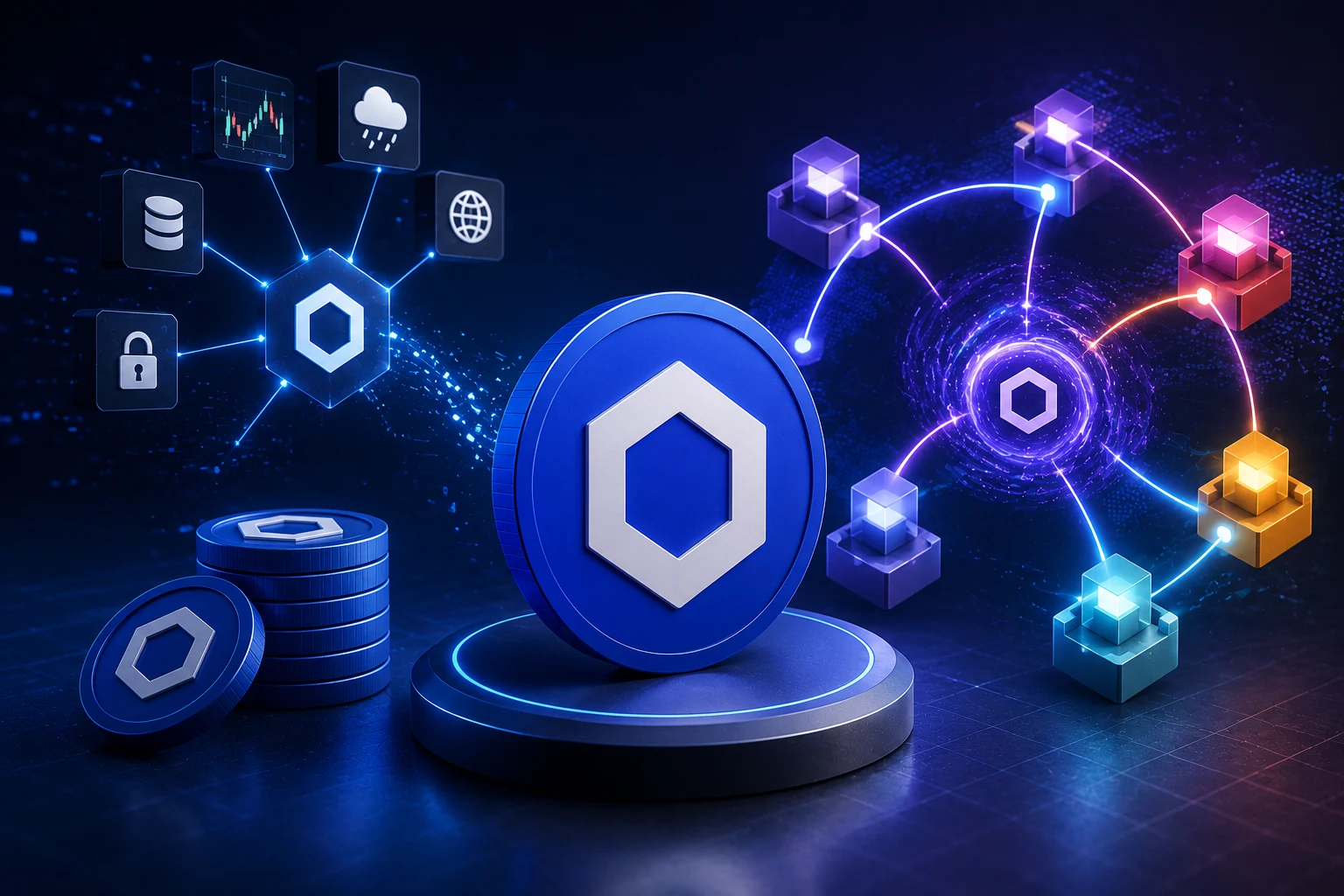
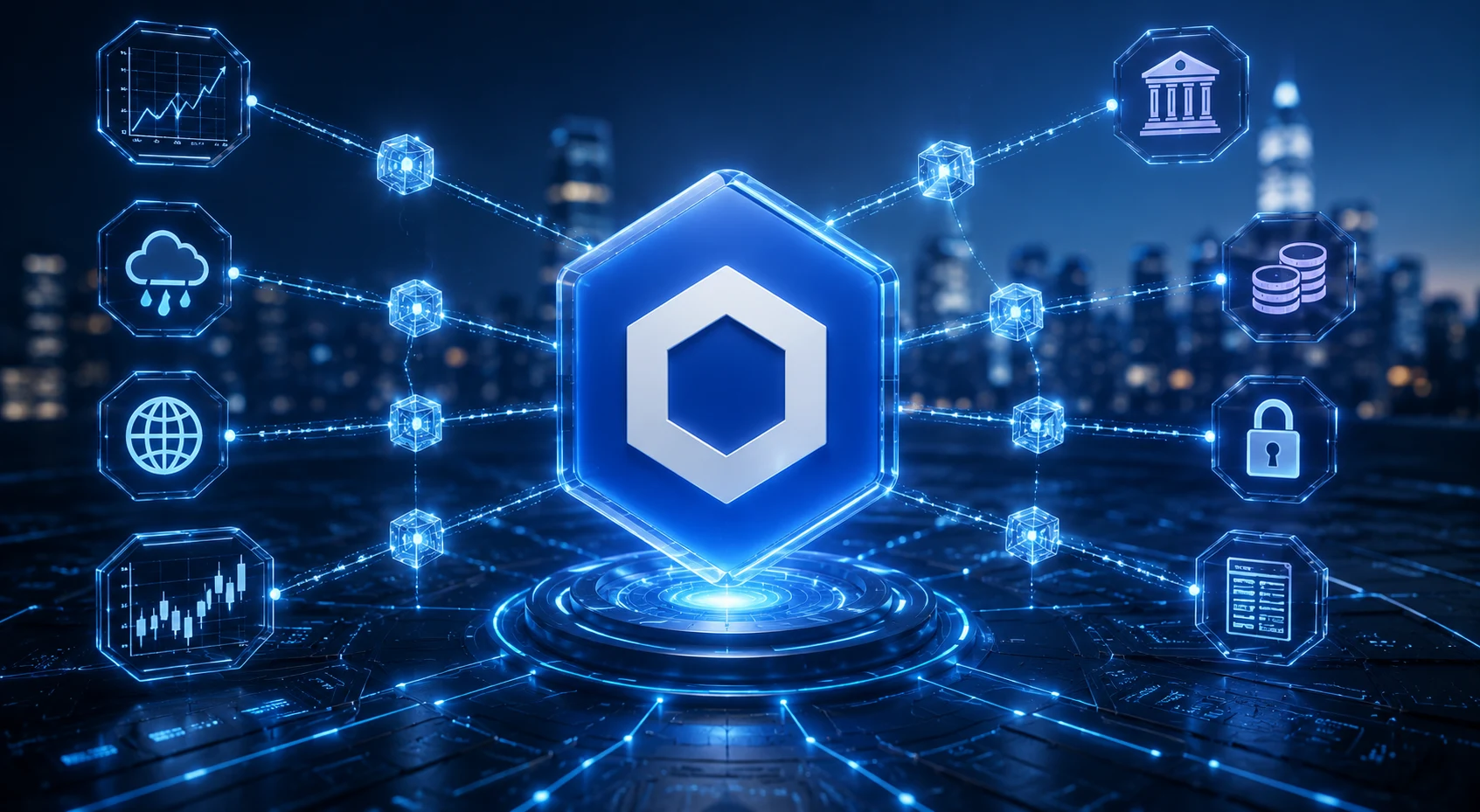
The base unit of Chainlink is a decentralized oracle network: a set of nodes that each fetch the same data from many sources, sign their result, and submit it to an on-chain aggregator. The contract trusts the aggregate, not any individual node. If one node lies, the aggregate moves only a little. If many nodes lie, the cryptoeconomic cost of being slashed makes it irrational. Decentralization comes from node diversity and from the structure of the aggregation.
Price feeds: the core product
Chainlink's most-used product is its price feeds. Each major asset has a dedicated network of nodes pulling its price from multiple exchanges and computing a volume-weighted aggregate. The aggregate is posted on-chain at regular intervals or when prices move significantly. Almost every major DeFi lending protocol, perpetuals platform, and synthetic asset chain reads from these feeds. They are the closest thing crypto has to a shared market truth.
VRF, automation, and Functions
Beyond price data, Chainlink runs several other oracle services:
- VRF (Verifiable Random Function) — provably fair randomness for on-chain games, NFT mints, and lotteries.
- Automation — triggers that let contracts run on a schedule or in response to conditions without a centralized cron job.
- Functions — general-purpose off-chain computation that returns results on-chain, useful for things like API calls and lightweight ML.
CCIP: the cross-chain protocol
Chainlink CCIP is a cross-chain messaging protocol that lets a smart contract on one chain trigger an action on another, with the same decentralized-oracle security model behind it. CCIP is positioning Chainlink as connective infrastructure between dozens of L1s and L2s. Token transfers, governance messages, and arbitrary contract calls can all flow through CCIP.
What the LINK token is for
LINK has two main roles, with a third growing:
- Payment to oracle nodes. Smart contracts that consume Chainlink data pay node operators in LINK for the work.
- Staking and security. Node operators stake LINK as a bond. Misbehavior can be slashed; honest performance earns rewards. Staking is being rolled out incrementally across services.
- Cross-chain economic asset. As CCIP grows, LINK plays a role in the economic security of cross-chain messages.
LINK is not a base-layer gas token the way ETH or SOL is. It is a payment and security token for an oracle and cross-chain network, which makes its economics different from a typical L1 token.
The Chainlink ecosystem
Chainlink is not a single ecosystem; it is a layer of infrastructure used across many ecosystems:
- DeFi — lending protocols, perpetuals, AMMs, and stablecoin issuers all depend on Chainlink feeds.
- Real-world assets and tokenization — bringing fiat reference rates, treasury yield, and proof-of-reserves on-chain.
- Gaming and NFTs — VRF provides provably random outcomes.
- Cross-chain DeFi — CCIP-powered liquidity, governance, and asset transfers across L1s and L2s.
- Institutional pilots — banks and clearing houses have piloted Chainlink for tokenized assets and cross-chain settlement.
Chainlink versus other oracle approaches
Chainlink is not the only oracle network. Pyth, RedStone, and others target overlapping use cases with different architectures — for example, push-based feeds that publish to many chains in lockstep, or pull-based feeds where the consumer signs and pays for fresh data on demand. Each has trade-offs around latency, cost, and decentralization. Chainlink's strength is its breadth and the depth of integrations: most DeFi was built on its feeds, and migration off is non-trivial.
The risks worth knowing
- Oracle dependency risk. If a major DeFi protocol depends on a Chainlink feed and that feed fails or is manipulated, the protocol can fail. Diversifying oracle sources is hard.
- Node operator concentration. Decentralization of node operators is a real and evolving question; major feeds use multiple operators, but the total set is still smaller than, say, an L1 validator set.
- Token volatility. LINK is a volatile asset and its price is loosely correlated with adoption of services, but the connection is far from mechanical.
- Cross-chain risk via CCIP. Cross-chain messages have historically been a weak point in crypto. CCIP is designed defensively, but cross-chain is still cross-chain.
- Competition. Pyth and others are eating into specific use cases (especially low-latency price feeds for trading), pushing Chainlink to respond.
None of this is investment advice. Treat any crypto position as money you can afford to lose.
Following Chainlink without the noise
Chainlink news spans price feed integrations, CCIP launches, staking rollouts, and institutional partnerships. Zippfeed surfaces Chainlink headlines with sentiment scoring (bullish, neutral, or bearish) and an importance rating, so you can see what actually moves the network instead of every API integration announcement. That is the difference between reading the signal and chasing oracle-related noise.

 Crypto News
 Crypto Capital Venture
 CryptoSlate