Why this question is harder than it looks
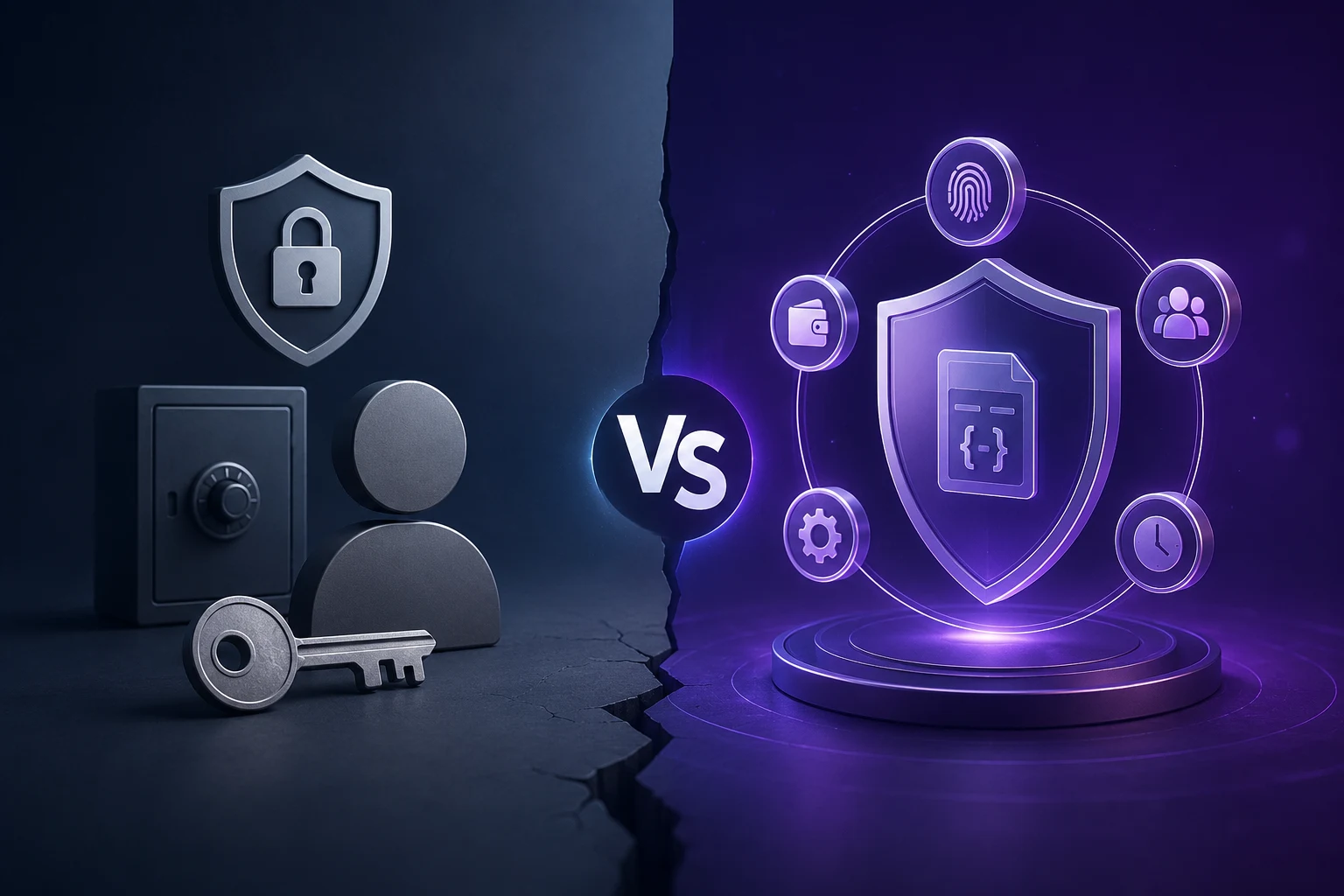
The pitch for smart accounts, sometimes called account abstraction, is that the externally owned account (EOA) model is a relic. A classic EOA is a single private key that signs every transaction on Ethereum. Lose the key, and the ETH and tokens are gone. Get the key phished, same outcome. Smart accounts, formalized in the ERC-4337 standard and related proposals, replace that single key with a smart contract wallet. That contract can require multiple signatures, allow spending limits, expire sessions, sponsor gas, and recover from a lost device through guardians.
On paper, this looks like a strict upgrade. In practice, every new feature is also a new way to lose money. Security researchers who audit these systems use a blunt framing: account abstraction does not reduce attack surface, it relocates it. A vulnerability that used to live in 'please don't lose your seed phrase' now lives in 'please don't misconfigure your guardian set, please trust a bundler not to front-run you, please trust a paymaster to stay solvent, and please notice a leaked session key before it gets used.'
This article walks through that relocation honestly. It is written for developers shipping smart-account integrations and for power users deciding whether to move real ETH into one. It assumes you already know what a seed phrase is and that you've heard the term 'account abstraction,' and it is not financial or security advice. Your setup, your threat model, and your tolerance for new dependencies are the variables that matter, not marketing decks.
What an EOA actually secures, and what it doesn't
An EOA is just a private key, the scalar number behind an Ethereum address. The address is a one-way function of that key. Sign a transaction, broadcast it, the network checks the signature against your address, and the state change happens. There is no smart contract between you and the chain. The simplicity is the security model: there is literally nothing else to break.
That simplicity is also the failure mode. The key is a 256-bit integer. A human cannot remember it, so wallets encode it as a seed phrase, usually 12 or 24 words from a fixed wordlist. Anyone with the seed phrase owns the account. There is no password reset, no customer support, no rate limit on bad signatures. Theft, when it happens, is final. According to Chainalysis-style estimates widely cited in the industry, billions of dollars in crypto have been lost to seed-phrase theft and phishing, and the chain itself is rarely the problem. The human, the clipboard, the browser extension, the fake website, the malicious transaction preview, those are the surfaces that actually fail.
Hardware wallets like Ledger and Trezor shift the private key off your computer, so a malware infection on your laptop can't sign a transaction you didn't approve. They don't change the on-chain model. Your EOA is still one key. Multisig wallets like Safe add an m-of-n signature requirement, so losing one key is recoverable. That helps, but it is a contract-level patch on top of an EOA-only chain. The base layer still doesn't know what a 'session' or a 'spending limit' is.
What a smart account actually adds, and what it costs
ERC-4337, the Ethereum standard for account abstraction, introduces four new actors and a new flow. Instead of a user signing a transaction directly, a smart-account user signs a UserOperation, a structured message describing what they want to do, including gas payment, signature, and any paymaster sponsorship. That UserOperation goes to a mempool, and a bundler packages one or more of them into a real on-chain transaction that calls the EntryPoint contract, which then calls each user's smart-account contract to validate and execute the operation.
Three new pieces matter for security. First, the smart-account contract itself, typically deployed from a factory like Create2, with logic for validating signatures, checking nonces, enforcing session keys, and handling recovery. Second, the bundler, an off-chain service that decides which UserOperations to include, in what order, and at what gas price. Third, the paymaster, a contract that can agree to pay gas on the user's behalf under rules the paymaster sets.
The cost is the dependency graph. You now trust the code of your account contract, the code of the EntryPoint, the bundler's ordering behavior, and the paymaster's solvency and rules. A traditional EOA trusts a single piece of cryptography. A smart account trusts a stack. That stack is auditable, but it is also a stack, with all the failure modes stacks bring: version drift, abandoned factories, deprecated EntryPoint versions, paymasters that rug, and bundlers that get hacked or sanctioned.
Session keys: the feature that quietly expands your blast radius
Session keys are one of the most useful smart-account features and one of the easiest to misuse. A session key is a temporary key, often scoped to a specific contract, a spending cap, and a time window, that lets a dapp sign UserOperations on your behalf without prompting you for a full signature every time. Game studios and trading apps use them because nobody wants to sign a transaction for every on-chain move in a fast loop.
The risk is structural. You have effectively minted a new EOA, funded it with a scoped allowance, and given it to a dapp. If the dapp's frontend is compromised, the attacker now holds that scoped key. If the session key is poorly scoped, the allowance can be drained inside the window. If revocation requires you to notice the leak and submit a UserOperation that revokes, the attacker has to lose a race against you, and the bundler has to be willing to include your revoke before the attacker's drain.
Several real incidents have demonstrated the pattern even before ERC-4337 went mainstream. In late 2023, a malicious version of the Ledger Connect Kit, distributed through a hijacked npm publisher account, briefly injected a drainer into dapps including SushiSwap and Zapper. Users with EOAs who signed the malicious transaction lost from their main account. Users whose smart accounts had granted broad session allowances faced a similar drain inside whatever scope the attacker could exploit. The blast radius was determined entirely by what the user had previously signed, not by the EOA-vs-smart-account distinction.
On the smart-account side, the lesson is that revocation must be cheap, fast, and ideally pre-armed. Revoking a session should not require a paymaster willing to sponsor gas, a bundler willing to include your tx, or a guardian to co-sign. If any of those are degraded, the revoke can stall, and the drain wins.
Paymasters and bundlers: new trust, new censorship
A paymaster is a contract that pays gas for UserOperations on behalf of users. The product story is that users can transact without holding ETH, a real UX win. The security story is that the paymaster sets the rules. It can reject your UserOperation, blacklist your address, or refuse to sponsor certain call types. It can also run out of funds and brick your flow mid-session. A paymaster you don't operate is a counterparty you didn't have with an EOA.
Bundlers are the equivalent counterparty for inclusion. With an EOA, you can always submit a transaction directly to the network, pay the base fee, and get included (modulo base-layer censorship, which is a separate topic). With ERC-4337, you depend on a bundler picking up your UserOperation. The bundler chooses order, and that ordering is where MEV lives. A malicious or compromised bundler can front-run your trade, sandwich your swap, or simply ignore you.
Trust-minimized bundlers exist, including decentralized networks that rotate proposers and use commit-reveal schemes to reduce front-running. They are not free. They add latency, cost, and operational complexity. A solo bundler that you run yourself is the closest you get to EOA-style trust assumptions, and it is also a single point of failure you now have to operate, monitor, and patch. The honest summary is that ERC-4337 is a multi-party system, and every new party is a new way for the system to fail or censor.
Incidents in adjacent stacks reinforce the pattern. MEV-Boost relays have been observed censoring OFAC-sanctioned addresses, and the relayer set had to be diversified. The same dynamic applies to bundlers. A small bundler market means a small censorship surface, and a small surface that a single actor can dominate. The system is more censorship-resistant in theory, but only if the bundler set is large, decentralized, and actively monitored.
Social recovery: a target when configured wrong
Social recovery replaces 'lose your seed phrase, lose everything' with 'lose your device, ask your guardians to restore you.' A smart account can designate N guardians and require a quorum, say 3 of 5, to rotate the signing key. It sounds like a strict upgrade. In threat-model terms, it changes who can take over your account, from 'anyone who steals the seed' to 'any quorum of guardians that an attacker can compromise.'
Poorly configured social recovery collapses the safety property. If all five guardians are family members on the same iCloud account, one compromised Apple ID is an account takeover. If three of the five are hot wallets on a phone you also use to sign into exchanges, the attacker who phishes your exchange login now has two of three votes. If a guardian is a smart contract that the user doesn't fully understand, an upgrade path in that guardian contract is a rotation path in your account. The security of the recovery flow is the security of the weakest guardian plus the security of the quorum threshold minus one.
Real attacks have hit this layer. In 2017, the Parity Wallet library bug froze hundreds of millions of dollars in ETH by killing the library contract that multisig wallets depended on. It was not a 'social recovery' incident in the ERC-4337 sense, but it is the same shape: a smart contract that controls recovery becomes a single point of failure. In 2024 and 2025, multiple incidents involving compromised frontends and hijacked npm or browser-extension publishers have shown that the supply chain a guardian depends on is part of the threat model. If your guardian is a hardware wallet, you also need to trust the manufacturer, the firmware update path, and the supply chain that delivered it.
The operational discipline is the same as multisig: guardian diversity across device classes, geographic and legal jurisdictions, and ideally across families of vendor. Recovery time, measured in days, is the metric that matters. A recovery that takes two weeks is a recovery that an attacker can outwait or socially engineer around, especially if the attacker can pressure guardians directly.
What this means for developers and power users
If you are building on top of smart accounts, the practical implications follow from the failure modes above. Default session keys to the smallest possible scope and the shortest possible lifetime. Make revocation a one-click action that does not depend on the paymaster or bundler being cooperative. Treat the paymaster as a contract counterparty in your threat model, including its solvency and its blacklist policy. Document the bundler assumptions your app makes, and run your own bundler if your users cannot tolerate front-running.
For audits, the smart-account stack has more places to look wrong than an EOA integration. The account contract itself, the EntryPoint version you target, the factory you deploy from, the paymaster logic, the bundler selection, the session-key validation, the guardian set, and the recovery flow all need separate review. Treating 'we use ERC-4337' as the security story is the equivalent of treating 'we use HTTPS' as the security story in a 2010 web app. It is a starting point, not an answer.
For power users holding real ETH, the decision is not 'smart account or EOA.' It is 'which risks am I currently exposed to, and which set of new risks is smaller for me.' A user who keeps a hardware wallet in a safe and never interacts with dapps has a small, well-understood risk profile. A user who trades on DEXs daily, signs session allowances, and bridges across chains has a much larger and more chaotic risk profile, and may genuinely benefit from smart-account features like scoped sessions and gas sponsorship, while accepting the new dependencies. The mistake is to assume the migration is a free upgrade. It is a reallocation of risk, and the new risks need their own mitigations.
Follow smart-account risk the smart way
Smart-account security moves fast, and so does the news around it. Tracking paymaster rug-pulls, bundler outages, session-key exploits, and audit disclosures manually is a losing game. Zippfeed surfaces smart-account and Ethereum security headlines with sentiment scoring (bullish, neutral, or bearish) and an importance rating, so you can spot real risk shifts before they hit your wallet. Treat the news feed as an early warning, not a trade signal, and pair it with the threat model in this article. smart account security vs eoa is exactly the kind of question where the signal is in the incident reports, not in the marketing.

 WuBlockchain
 Crypto Capital Venture
 Lookonchain
 TheBlock