Arbitrum in context
Ethereum's biggest problem in 2021 was simple: success had made it expensive. A swap could cost $30, a complex DeFi position $100 or more. The community had bet on Layer 2 rollups as the answer — chains that run their own execution but settle to Ethereum and inherit its security. Of the rollups that launched, Arbitrum moved fastest in attracting users, developers, and total value.
Today Arbitrum is the largest Ethereum L2 by total value locked and one of the highest-throughput application platforms in crypto. It is also the chain most developers compare against when evaluating other L2s.
How Arbitrum actually works
Optimistic rollups in one paragraph
An optimistic rollup bundles thousands of transactions, executes them on its own chain, and posts the transaction data and resulting state back to Ethereum. "Optimistic" means the state is assumed correct unless someone challenges it within a fraud-proof window (currently about seven days). If a challenge succeeds, the invalid state is rolled back and the bad actor is punished. If no challenge comes, the state finalizes. The model is much cheaper than recomputing every transaction on Ethereum mainnet while keeping Ethereum-level security guarantees. Our explainer on Layer 2 blockchains walks through the broader category.
The Arbitrum Stylus upgrade
Arbitrum is fully EVM-compatible, meaning Solidity contracts written for Ethereum deploy to Arbitrum One with no changes. The Stylus upgrade added support for Rust and other languages that compile to WebAssembly, which sit alongside the EVM. That makes Arbitrum unusual: most rollups are pure EVM, while Stylus opens the door to high-performance non-Solidity contracts.
One versus Nova
Arbitrum runs two main chains:
- Arbitrum One — the flagship general-purpose chain. It posts transaction data to Ethereum mainnet as calldata, which is the most secure but slightly more expensive option.
- Arbitrum Nova — uses a data-availability committee for cheaper data storage, lowering fees further at the cost of slightly different security assumptions. Nova is targeted at high-volume, lower-value applications like gaming and social media.
The withdrawal delay
Because of the fraud-proof window, withdrawing assets from Arbitrum to Ethereum mainnet takes about seven days through the canonical bridge. Third-party fast bridges work around this by fronting the user instantly and waiting out the window themselves, in exchange for a fee. Most users never notice the delay because they trade within the L2 ecosystem.
What the ARB token is for
ARB is unusual among L2s in being a pure governance token:
- Governance. ARB holders vote on the Arbitrum DAO, which controls the protocol treasury, key upgrades, and grant programs.
- Treasury and grants. The DAO disposes of a large treasury denominated in ARB, used for ecosystem incentives, builder grants, and security work.
- No gas role. ARB is not the gas token of Arbitrum. Gas on Arbitrum is paid in ETH — the same as mainnet, just much cheaper.
The choice to keep gas in ETH was deliberate: it preserves UX continuity with Ethereum and avoids forcing users to acquire a separate token to transact.
The Arbitrum ecosystem
Arbitrum hosts one of the deepest DeFi ecosystems outside Ethereum mainnet:
- DeFi — the largest perpetuals platforms, AMMs, lending markets, and yield protocols all have major Arbitrum deployments.
- NFTs and gaming — Nova in particular is positioned for game studios that need cheap, high-throughput economies.
- Cross-chain liquidity — Arbitrum is a major bridge destination for assets and a settlement venue for cross-chain protocols.
- Orbit chains — projects can launch their own Arbitrum-derived rollup that settles to Arbitrum One, creating an L3 ecosystem.
Arbitrum versus other Layer 2s
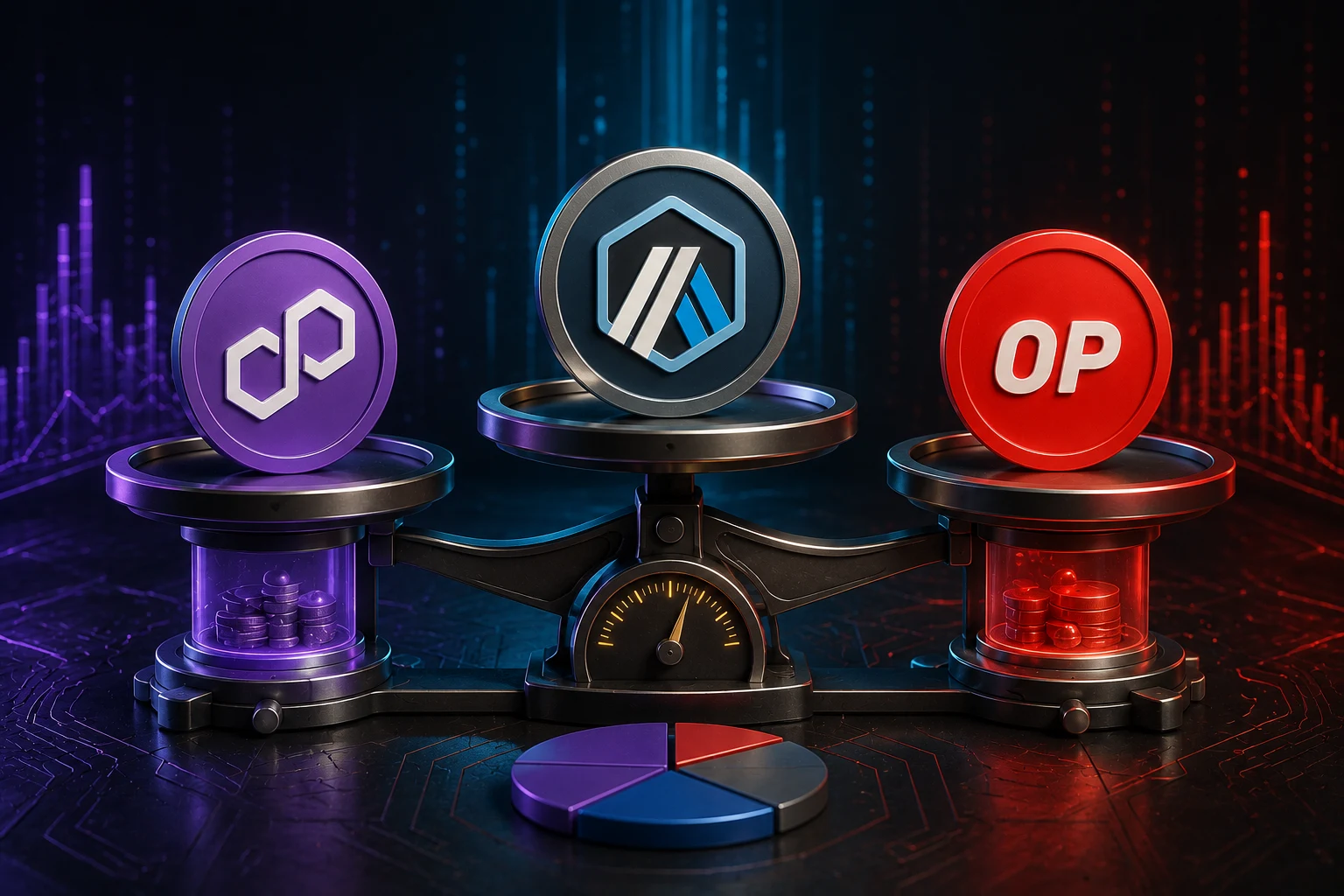
The main comparison is with Optimism and other EVM rollups like Base and zkSync. Arbitrum and Optimism are both optimistic rollups with similar security models. Their differences are in the technical details (fraud-proof system, sequencer design), the ecosystem composition, and the governance dynamics around their tokens. Base, built by Coinbase, is also an optimistic rollup and is the fastest-growing L2 by some measures. Zero-knowledge rollups (zkSync, Polygon zkEVM) take a different approach to scaling, using cryptographic proofs instead of fraud-proofs. Each model has trade-offs around finality speed, complexity, and gas cost.
The risks worth knowing
- Centralization of the sequencer. Arbitrum currently runs a single sequencer that orders transactions before posting them to Ethereum. A centralized sequencer can in principle censor or reorder transactions, though the data and state can still be reconstructed from Ethereum. Decentralizing the sequencer is on the roadmap.
- Fraud-proof finality delay. Optimistic rollups inherit Ethereum security but require the fraud-proof window for canonical withdrawals. Fast bridges work around this but add their own trust assumptions.
- Competition. The L2 space is crowded. Base, Optimism, and zk rollups are all competing for ecosystem mindshare and TVL.
- Token volatility. ARB is a volatile asset, and the governance-token-only role makes its economics different from a gas token. The connection between protocol use and ARB price is loose.
- Governance dynamics. The Arbitrum DAO is large and active, but governance is harder than it looks and decisions have sometimes attracted criticism around proposal process and treasury management.
None of this is investment advice. Treat any crypto position as money you can afford to lose.
Following Arbitrum without the noise
Arbitrum news spans protocol upgrades, governance proposals, sequencer changes, and ecosystem launches. Zippfeed surfaces Arbitrum headlines with sentiment scoring (bullish, neutral, or bearish) and an importance rating, so you see what actually moves the network instead of every microcap launch or DAO motion. That is the difference between reading the signal and chasing L2 threads.

 CoinDesk
 CryptoSlate
 Crypto Rank News
 WuBlockchain