Toncoin in context
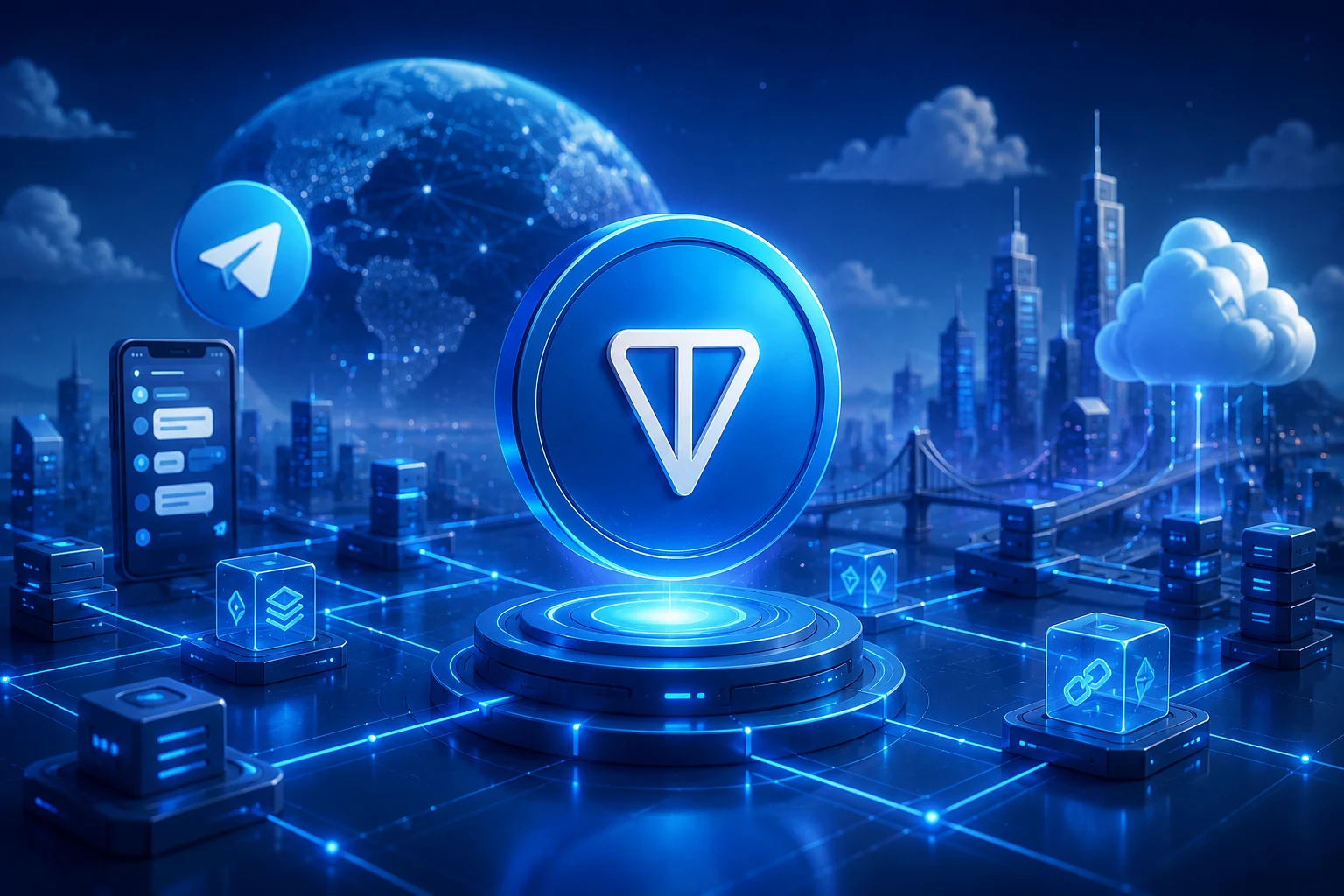
The Open Network started life as a Telegram project: founders Pavel and Nikolai Durov designed it as a blockchain that could scale to messenger-level user volumes and settle payments inside Telegram. After regulatory action by the U.S. SEC in 2020, Telegram itself stepped back from operating the network, and an independent community took over its development. The chain re-emerged as TON, with Toncoin as the native asset.
What did not go away was the Telegram connection. The messenger has integrated TON wallets, supports TON-denominated payments and tips, and has become a launchpad for mini-apps that use TON as their economic substrate. That bridge to a billion-user messenger is the single most important fact about TON's growth.
How TON actually works
Sharded proof of stake
TON is a proof-of-stake chain that uses sharding to scale. Instead of a single chain processing every transaction, TON splits work across many shard chains organized into workchains. A masterchain coordinates consensus across the shards. The design lets the network theoretically scale to very high transaction throughput by adding shards as load grows.
The technical model is ambitious. Whether it has delivered on its scaling promises in practice is a fair question, and real-world throughput has been more modest than the theoretical maxima. What is undeniable is that the chain is fast and cheap in normal usage — block times of a few seconds and fees that are fractions of a cent.
The Telegram integration
Telegram's official wallet — accessible inside the messenger — gives users a fiat-on-ramp, a TON balance, and the ability to send TON or tap-to-pay merchants without leaving the chat. This integration is the closest crypto has come to a true consumer-grade onboarding flow. A user on Telegram can have a working crypto wallet without installing anything else.
The mini-app ecosystem is the second leg of the Telegram thesis. Developers can build apps that run inside Telegram (web apps with chat-native UI), and many use TON as their economic backbone — for in-app purchases, tipping, rewards, and play-to-earn loops. Whether those mini-apps build durable businesses or fade as hype cycles end is one of the most important questions facing TON.
What the TON token is for
TON has multiple roles:
- Gas. Every transaction on TON pays a small TON fee.
- Staking. Validators stake TON to participate in consensus and earn rewards; delegators back validators with their TON.
- Governance. TON holders vote on protocol parameters and treasury decisions.
- In-Telegram payments. TON is the native unit for tips, mini-app payments, and growing categories of Telegram-side commerce.
- DNS and naming. TON DNS uses TON for registering blockchain-native names.
The TON ecosystem
TON's ecosystem is shaped by its Telegram roots:
- In-messenger payments and tips — the highest-friction problem solved better here than almost anywhere else in crypto.
- Mini-apps — games, social, financial, and content apps that run inside Telegram and settle on TON.
- DeFi — DEXs, lending markets, and stablecoin liquidity, smaller than on Ethereum or Solana but growing.
- NFTs and digital collectibles — including Telegram usernames and anonymous numbers tokenized on TON.
TON versus other ecosystems
The honest comparison is not technical — it is about user acquisition. Where Ethereum optimizes for the deepest developer ecosystem and Solana for raw performance, TON optimizes for distribution. Telegram has hundreds of millions of users, and TON is the only blockchain with that kind of built-in messenger funnel. The technical model is competent without being best-in-class on any single dimension; the strategic edge is the user pipe.
That makes TON a unique case in crypto. Most chains struggle to acquire users. TON struggles to convert messenger users into durable crypto-native usage. Those are very different problems.
The risks worth knowing
- Telegram dependence. A huge fraction of TON's value proposition comes from its tight Telegram integration. Changes in Telegram's policies, leadership situation, or jurisdictional standing could affect that pipeline in ways the chain cannot control directly.
- Regulatory complexity. The original TON sale settled with the U.S. SEC, and Telegram itself has faced regulatory scrutiny in multiple jurisdictions. Future enforcement could touch the chain.
- Sustainability of mini-app activity. Mini-app hype cycles can inflate activity that does not persist. Real adoption metrics need to be read carefully.
- Token volatility. TON is a volatile asset. The Telegram narrative has driven sharp moves in both directions.
- Centralization of distribution channels. Most user-facing TON activity flows through Telegram-controlled surfaces. That is a strength for adoption and a risk for sovereignty.
None of this is investment advice. Treat any crypto position as money you can afford to lose.
Following TON without the noise
TON news mixes protocol updates, mini-app launches, Telegram product moves, and regulatory headlines into one fast stream. Zippfeed surfaces TON headlines with sentiment scoring (bullish, neutral, or bearish) and an importance rating, so you see what actually moves the network instead of every mini-app airdrop. That is the difference between reading the signal and chasing Telegram-channel hype.

 Altcoin Daily
 CoinDesk
 Crypto Rank News
 CryptoSlate