Polkadot in context
By 2017 a pattern had emerged in crypto: every new use case wanted its own chain, but every new chain had to bootstrap its own validator set, fight for its own liquidity, and figure out its own bridges. Each new chain looked like a fresh island, often less secure than the last because attackers could rent enough hash power or stake to attack a small network for far less than it cost to attack Bitcoin or Ethereum.
Polkadot was designed to make that pattern unnecessary. Instead of dozens of small chains each providing their own security, one large network would provide pooled security to many specialized chains. Teams could focus on what made their chain unique — gaming, DeFi, identity, privacy — and inherit the security of the whole network.
How Polkadot actually works
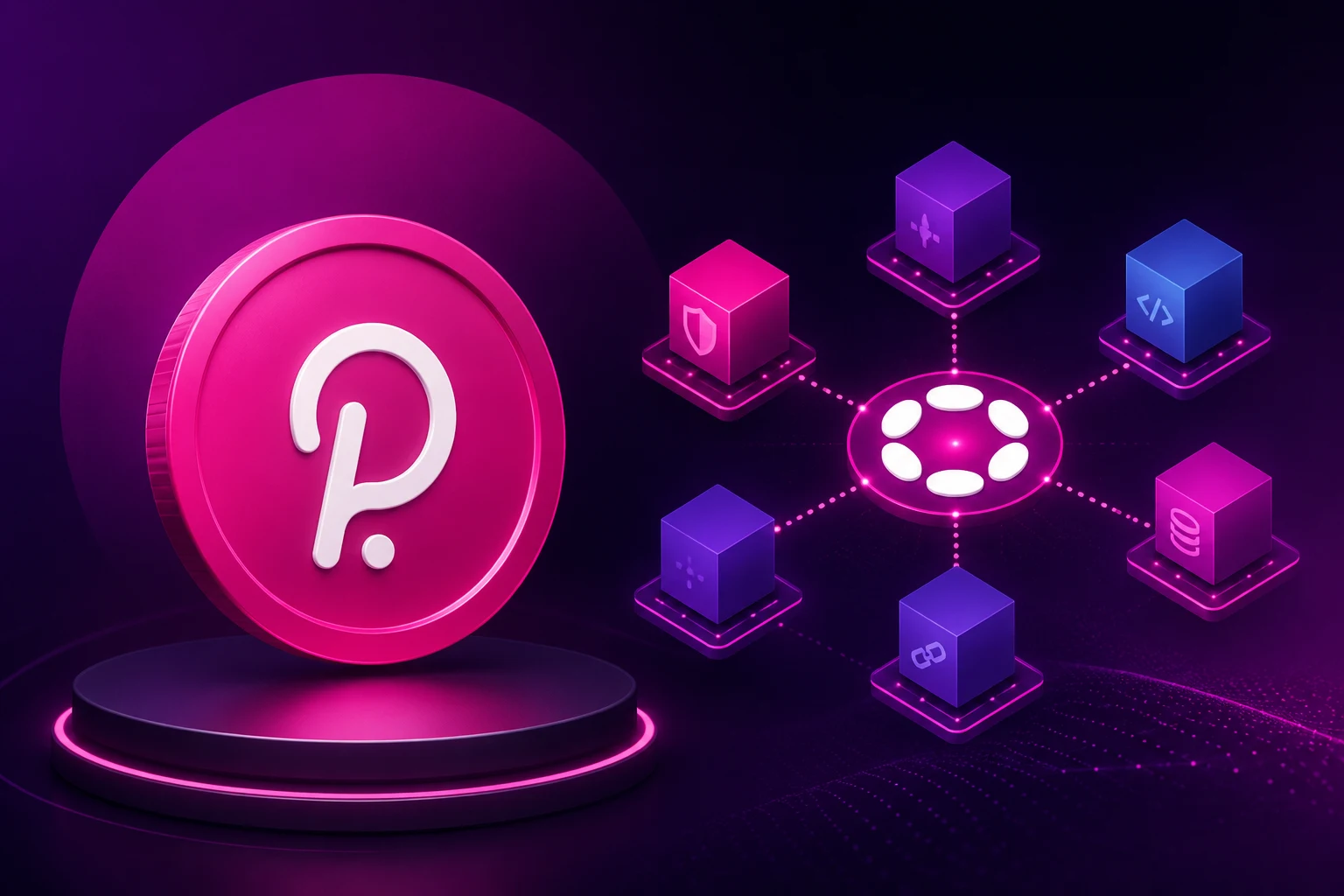
Polkadot is best understood as three layers cooperating: the relay chain, the parachains, and the validators that connect them.
The relay chain
The relay chain is the central spine of Polkadot. It does not run user-facing applications; it does not host smart contracts. Its only job is to finalize blocks across the network and provide shared security to the chains plugged into it. Keeping the relay chain simple is what makes it possible for it to scale to many parachains.
Parachains
A parachain is an independent blockchain that connects to Polkadot's relay chain. Each parachain can have its own state, its own runtime, its own consensus rules — but its blocks are validated and finalized by Polkadot's relay chain validators. A parachain inherits the security of the whole network without having to build its own validator set.
Parachains can also message each other through a cross-chain messaging system called XCM. A token on parachain A can be sent to parachain B and back, with the security guarantees of the underlying relay chain. That is the part Polkadot calls "interoperability," and it is the thing competitors do not quite have in the same shape.
Substrate: the chain framework
Most parachains are built with Substrate, the modular blockchain framework the Polkadot team developed. Substrate is what makes spinning up a custom chain feasible — you compose pre-built pallets (consensus, balances, governance, EVM) instead of writing everything from scratch. Chains built with Substrate do not have to connect to Polkadot, but the framework was designed with that path in mind.
From auctions to coretime
For the first few years, parachain slots were allocated through crowdloans and competitive auctions — projects locked up DOT for two years to win the right to be a parachain. That model worked but limited the number of teams that could plug in. In 2024 the network shifted to coretime, a system where parachains rent blockspace from the relay chain on a more flexible, pay-as-you-go basis. The change made it easier for new teams to onboard without locking up huge amounts of DOT for years.
What the DOT token is for
DOT has three core roles:
- Governance. DOT holders vote on protocol upgrades, treasury spending, and network parameters through Polkadot's on-chain governance system (OpenGov).
- Staking. DOT is staked by validators and nominators to secure the relay chain and earn rewards.
- Coretime and bonding. DOT is used to acquire blockspace on parachains and was historically locked in auctions for parachain slots.
Staking on Polkadot uses a nominated proof-of-stake model: nominators back validators with their DOT, validators run the network, and slashing penalizes both sides if a validator misbehaves. If you want the broader picture of how this kind of staking works across chains, our explainer on proof of stake walks through the trade-offs.
The Polkadot ecosystem
The parachain ecosystem is broad and specialized:
- Smart contract chains — parachains like Moonbeam and Astar offer EVM-compatible execution, letting Solidity contracts run inside Polkadot's security model.
- DeFi parachains — purpose-built chains for AMMs, lending, derivatives, and stablecoin liquidity.
- Identity, privacy, and Web3 infrastructure — chains focused on credentials, encrypted compute, and decentralized storage.
- Asset chains — Polkadot Asset Hub is the official chain for issuing and managing assets across the network.
Polkadot versus other ecosystems
Polkadot's closest comparison is Cosmos. Both are multi-chain networks, both let teams build custom chains, both focus on interoperability. The difference is the security model: Cosmos chains each run their own validator set by default, with shared security as an opt-in; Polkadot's model is the reverse, with shared security as the default and chains running independently only by choice. Both approaches have strengths and trade-offs.
Compared with monolithic chains like Ethereum or Solana, Polkadot's pitch is specialization: instead of every application competing for blockspace on one chain, each application gets a chain tuned to its needs. The downside is that liquidity and developer attention can fragment across parachains in a way they do not on a single dominant chain.
The risks worth knowing
- Ecosystem fragmentation. The multi-chain model splits liquidity, users, and developer mindshare across parachains. Bridges between them work but add a layer of complexity that single-chain ecosystems avoid.
- Governance dynamics. On-chain governance is powerful but slow, and OpenGov in particular relies on active participation that has been uneven.
- Adoption and developer growth. Polkadot's developer count and total value locked sit well below Ethereum and Solana. Strong technology does not automatically translate into ecosystem dominance.
- Token volatility. DOT is a volatile asset and has seen long drawdowns from its highs.
- Coretime is new. The shift away from parachain auctions is recent. Market dynamics around coretime pricing and parachain rotation are still being discovered.
None of this is investment advice. Treat any crypto position as money you can afford to lose.
Following Polkadot without the noise
Polkadot news is split across the relay chain, dozens of parachains, governance votes, and coretime markets. Zippfeed surfaces Polkadot headlines with sentiment scoring (bullish, neutral, or bearish) and an importance rating, so you see what actually moves the network — runtime upgrades, big parachain launches, governance decisions — instead of every micro-update from every parachain. That is the difference between reading the signal and drowning in cross-chain noise.

 CryptoSlate